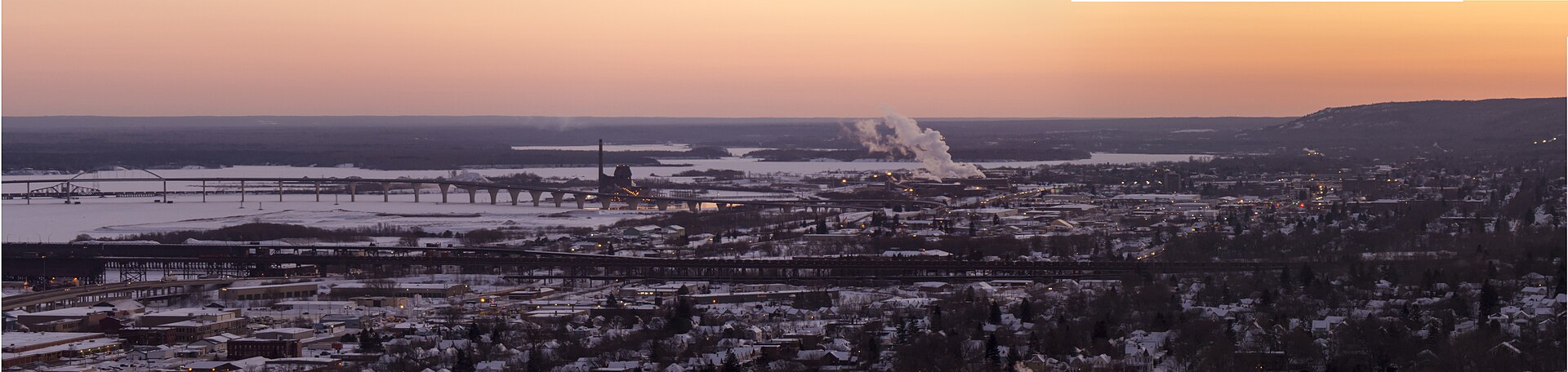
People ask this in two different tones. Some are asking whether they can handle it. Some are hoping to be told it is exaggerated.
It is not exaggerated. It is also not the thing that makes people leave. Here are the actual numbers and the parts that matter more than the numbers.
The numbers
The 1991 to 2020 normal at the National Weather Service office near Duluth International Airport is 90.2 inches of snow per season.
The record season was 2022 to 2023, at 140.1 inches, which broke the previous record of 135.4 inches set in 1995 to 1996. Records here run back to 1886 (NWS Duluth, accessed 2026-08-13).
So: expect around seven and a half feet in an ordinary year, and know that the ceiling is closer to twelve. Snow can fall from October into April.
What the averages do not convey is duration. This is not a city where snow arrives, causes drama, and melts. It arrives and stays, and the ground is white from roughly December to late March most years. If you are coming from a place where winter is a series of events rather than a season, that is the adjustment.
The part that decides which house you should buy
Duluth's winter is not uniform across Duluth, and this is the single most useful thing in this article.
Lake-effect favors the east. Bands coming off Lake Superior hit the eastern shoreline hardest. Lakeside, Lester Park and the North Shore strip regularly get more than the airport normal, while the far west end sees noticeably less. It is entirely normal for the east end to take six inches while the west end takes one from the same system. Residents here read wind direction rather than forecast totals.
Elevation adds more. Above-the-hill neighborhoods accumulate more and run colder overnight than the lakeshore. Bayview Heights sits at roughly 1,200 feet against about 600 for the West Duluth neighborhoods below it, and the difference shows up as snow on the ground and as power outages that last longer.
Grade decides your morning. This is the real cost. Duluth is built on a hillside, and main routes are typically cleared before residential streets. A hillside avenue after a big storm is a genuine obstacle, and the difference between a house on a flat street and one halfway up a numbered avenue is a daily fact for four months. Which priority a given street sits on is a question for the city, and a fair one to ask before you buy.
Flat ground is an underrated luxury. Morgan Park sits on level river-terrace ground. Canal Park is flat and commercial, so it is cleared early. Superior, across the bay, is flat throughout. In winter these are meaningful advantages that never appear in a listing.
What it actually costs you
Heating. The biggest line item, and the most variable. An uninsulated older house and a retrofitted one of the same size are different financial propositions. Ask for two or three full seasons of real utility history rather than an average.
Your car, and your tires. Good winter tires matter more than all-wheel drive, though on a hillside both help. Low-clearance cars are a poor bet on unplowed residential blocks.
Snow removal. A snowblower is standard equipment, not a luxury. If the property has a long driveway, that is a recurring cost in either money or Saturday mornings.
Roof and ice dams. Snow sitting on a roof for months, plus an under-insulated attic, produces ice dams: meltwater refreezing at the cold eave and backing up under the shingles. Close to universal on older north-facing east-side roofs. Fix the attic, not the roof.
Darkness. Rarely mentioned and genuinely significant. In late December it is dark by mid-afternoon. Some people find this the hardest part of the season, harder than the cold, and it is worth knowing about yourself before you commit.
What it gives back
This part is real, and it is why people stay.
Winter here is a season with things in it rather than a season to be endured indoors. Spirit Mountain is ten to fifteen minutes from most of the city for downhill skiing and tubing. The Duluth Traverse and the Lester, Piedmont and Magney-Snively systems carry Nordic skiing, snowshoeing and fat biking. Outdoor rinks run all winter. Chester and Hartley are minutes from most east-side addresses.
And the Lakewalk is cleared through much of the season, which makes it the most dependable walking and running surface in the city for five months.
Then there is the lake itself. Storm watching in November, when waves come over the Canal Park piers. Ice building on the piers and the North Pier Lighthouse in formations that draw photographers from across the Midwest. Sea smoke on a clear morning at twenty below. These are not consolations. For a lot of residents they are the reason.
The other half of the bargain is summer. The same lake that makes winter long makes July superb, and Duluth in summer is one of the most pleasant places in the country.
The honest verdict
The winter will not beat you on temperature. Cold is solvable with clothing and most people adapt within a season.
What people underestimate, in order: the length, the dark, and the hill. A person who moves here and buys a house halfway up a steep avenue, with a long driveway and an under-insulated attic, will have a harder first winter than someone on flat ground four blocks away, and will blame Duluth rather than the house.
So the practical advice is not about attitude. It is this: drive the commute you are proposing, uphill, in February, before you buy. Ask which snow-clearing priority the street is on. Ask for the heating bills. And look hard at whether you are buying on the east shoreline, where the lake-effect lands, or the west end, where it mostly does not.
Get those four things right and a Duluth winter is a season you will end up defending to visitors. Get them wrong and it is the reason you list the house in April.
Winter ease is a rated field on every neighborhood page, and it varies more than almost anything else. See it compared directly in East Duluth vs West Duluth, which covers the lake-effect split, and Duluth Heights vs Piedmont, where the two neighborhoods sit a full point apart.