East Duluth
The lake on one side, the trails on the other, and the city's oldest intact streetscapes in between.
Living in East Duluth
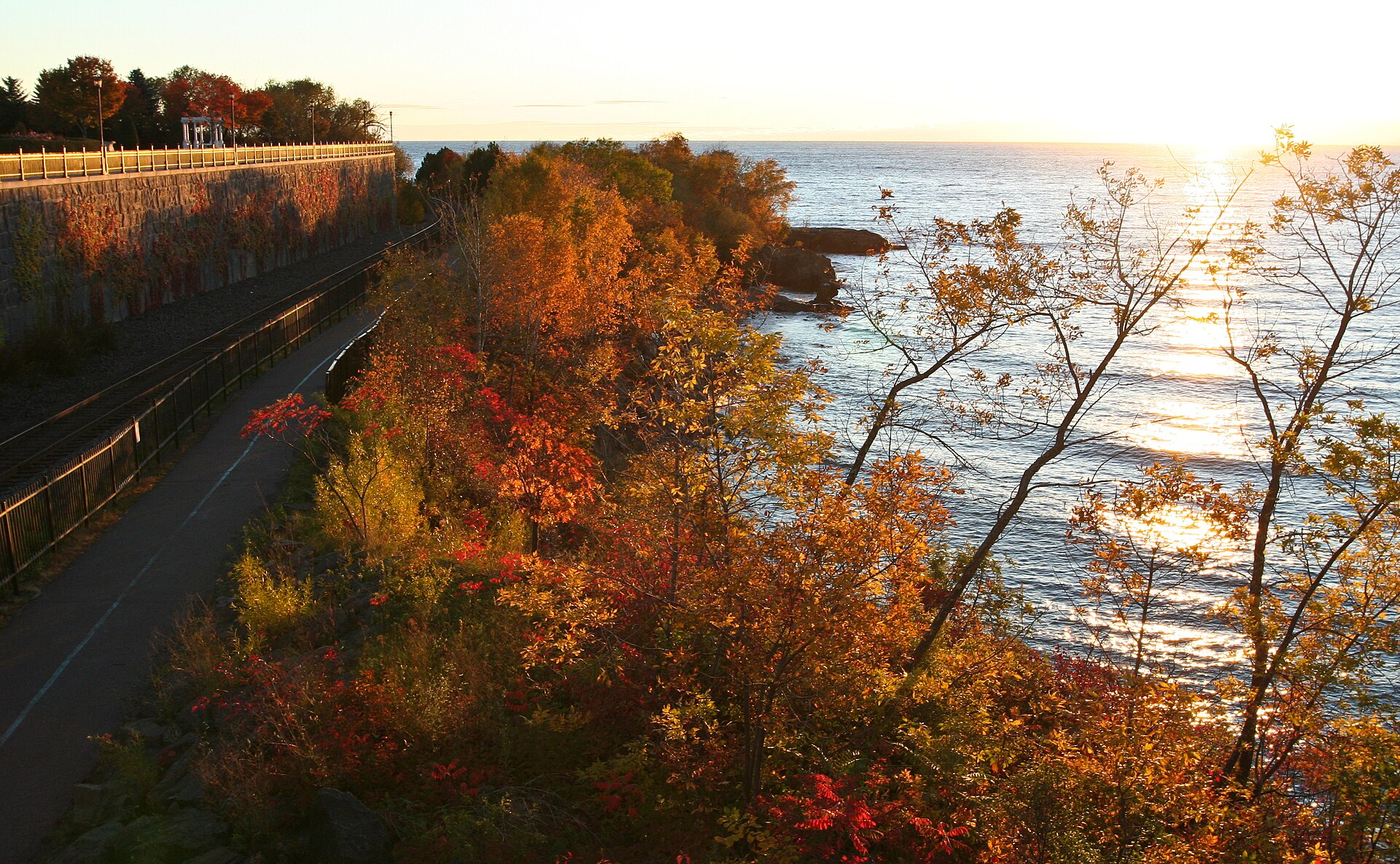
East Duluth is what most people picture when they picture Duluth: houses stepping up a hill above a very large lake, mature elms and maples over the streets, and a trailhead within walking distance of nearly every address.
The region runs roughly from 10th Avenue East out to the Lake County line, a distance of about twelve miles, with the lake on the southeast and Skyline Parkway and the ridge above. Everything here is organized by that slope. Streets run either along the hill or straight up it, views improve with elevation, winter driving gets harder in the same direction, and the housing changes as you climb. Understanding the slope explains most of what varies in price from block to block.
Chronology explains the rest. The region was built from downtown outward, so the housing gets newer as you move east. East End and Endion went up first, in the boom decades when the ore and grain money arrived, and its blocks still carry both the mansions of that era and the dense worker housing built alongside them. Congdon Park followed as a planned enclave between 1905 and 1935 and has changed remarkably little since. Hunter's Park and Woodland grew along the streetcar lines. Lakeside and Lester Park filled in through the mid-century as conventional family neighborhoods. The North Shore strip past Lester River never filled in at all, and is still a thin line of houses between the highway and the water.
The unifying practical fact is schools. Every neighborhood in this region feeds Ordean East Middle School and then Duluth East High School, which is the largest high school in the district at roughly 1,495 students (NCES, accessed 2026-08-13). Families who care mainly about the high school can shop across a price range from the $180,000s to over $900,000 without changing the answer. That is unusual, and it is the most useful single fact about buying here.
The second unifying fact is parks. Duluth maintains roughly 170 greenspaces totaling about 12,000 acres, close to a quarter of the city's land area (City of Duluth, accessed 2026-08-13), and this region holds a disproportionate share of the good ones. Hartley Park, Lester Park, Congdon Park, Chester Park and the Lakewalk are all inside it or on its edge, and the Superior Hiking Trail and the Duluth Traverse singletrack both run through. Trail access is not a bonus feature in East Duluth. It is the reason a large share of buyers choose the region over cheaper ground elsewhere in the city.
What East Duluth is not is cheap, and it is not uniformly expensive either. Congdon Park posted a June 2026 median of $645,000, which distorts every average the region appears in (Redfin, accessed 2026-08-13). Strip Congdon out and the picture is ordinary: East End at about $258,000, Hunter's Park at $275,000, Lakeside and Lester Park both near $303,000. Those sit at or slightly above the citywide median of roughly $290,000. A buyer who writes off the whole east side after seeing one Congdon number is making an expensive mistake in the other direction.
The trade-offs are consistent across the region. The housing is old, which means real inspection homework: knob-and-tube remnants, plaster, ice dams on north-facing roofs, and radon given the bedrock. Lots are often steep or irregular. The farther east you go the longer everything takes, and the North Shore strip in particular trades a twenty-minute drive for lake frontage and near-total quiet. Inventory is thin nearly everywhere, because these are neighborhoods people stay in.
What homes cost here: Roughly $185,000 to $950,000 across the region, June 2026. Outside Congdon Park the working range is the mid $200,000s to the low $400,000s (Redfin neighborhood data, accessed 2026-08-13). Exact per-neighborhood medians live on the neighborhood records and should be rendered from them, not copied here.
Every neighborhood in East Duluth
Chester Park
Congdon Park
The city's premium address: a nearly intact 1905 to 1935 streetscape with a creek and a stone-bridged park running through it.
East End / Endion
The boom-era hillside directly above downtown, where mansion blocks and dense streetcar-era housing sit within a few streets of each other.
Hunter's Park
Curving streets and turreted houses on the upper edge of the east side, with Hartley Park at the end of the block.
Lakeside
A walkable village center three blocks off the lake, and the most conventional family housing on this side of town.
Lester Park
Two rivers, a waterfall, and the trailhead for the largest park system in the city.
North Shore (Duluth)
Duluth's last two miles before the county line: lakefront on one side of Highway 61, woods on the other.
School districts serving East Duluth
The whole region sits in Duluth Public Schools (ISD 709) and shares a secondary pathway: Ordean East Middle School, roughly 1,037 students, then Duluth East High School, roughly 1,495 students (NCES, accessed 2026-08-13). Duluth East is the larger of the district's two comprehensive high schools and carries the broader course catalog that comes with size.
Elementary assignment is where the region divides, and it is worth checking against a specific address rather than a neighborhood name. Congdon Park Elementary serves Congdon and parts of the East End. Homecroft Elementary serves Hunter's Park. Lester Park Elementary serves both Lakeside and Lester Park. Lakewood Elementary serves the North Shore strip and is the smallest of them at about 254 students.
For private options, Marshall School is an independent K-12 on the upper east side, and Stella Maris Academy operates Catholic campuses across the city. The College of St. Scholastica and the University of Minnesota Duluth both sit on or just above the region's western edge.
Attendance boundaries change, and a few edges in this region are genuinely ambiguous in the published maps. Confirm assignment with ISD 709 for the exact address before it factors into an offer.
Commute profile
On these figures: Regional midpoints across the six neighborhoods. The spread is wide and it is the single most useful thing to know about this region: downtown runs 5 minutes from East End and 20 from the far end of the North Shore strip.
Downtown is the reference point and the range is wide: about 5 minutes from East End, 8 from Congdon, 10 from Hunter's Park, 14 from Lakeside, 17 from Lester Park, and about 20 from the far end of the North Shore strip. Miller Hill, where most of the region's big-box shopping and the largest grocery stores are, runs about 8 to 22 minutes on the same gradient. Superior is 12 to 28 minutes across the bridges, and the airport 12 to 26.
London Road and Superior Street East are the through routes along the lake, with I-35 available for the inner half of the region and Highway 61 taking over past Lester River. Woodland Avenue and Glenwood Street climb the hill. Skyline Parkway runs the ridge and is scenic rather than practical, and parts of it close in winter.
Duluth Transit Authority route 103 serves the London Road and Lakeside corridor, which covers Congdon, Lakeside and Lester Park. Coverage thins considerably above the main corridor and past Lester River, so the upper and outer parts of the region are effectively car-dependent (DTA, accessed 2026-08-13).
Winter is the real variable. The side streets here are steep, wooded and narrow in places. The city plows competently and the arterials are reliable, but a north-facing hill street after a freeze is a different proposition from a flat grid, and lake-effect snow lands harder on the eastern end of the region than downtown. Anyone moving here from flat ground should plan on winter tires rather than treating them as optional.
Who East Duluth suits
East Duluth suits households that want mature neighborhoods, walkable or trail-adjacent daily life, and a single predictable school pathway, and who are prepared to buy old housing and do the inspection work that comes with it.
It works well for families weighing the high school first, because the whole region answers that question the same way across a very wide price range. It works for outdoor-oriented households, since trail access is genuinely at the door rather than a drive away. It works for buyers who value architecture and are willing to trade a modern floor plan for a 1910 one. And the East End end of the region works for first-time buyers and small investors, who often assume the east side is closed to them and find out otherwise.
It suits people less well if new construction matters, because there is almost none. If a flat lot, a wide driveway and an easy winter approach are priorities, the neighborhoods above the hill will serve better. If the budget is firmly under $200,000, the west side of the city offers considerably more house per dollar. And if a short drive to big-box shopping is a daily need, Miller Hill is closer from almost anywhere else.
Common questions about East Duluth
Which neighborhoods are in East Duluth?
Eight: East End and Endion, Congdon Park, Chester Park and UMD, Hunter's Park, Morley Heights and Parkview, Lakeside, Lester Park, and the North Shore strip out past Lester River. This guide covers six of them so far; Chester Park and Morley Heights have pages in production.
Is East Duluth more expensive than the rest of the city?
On average yes, but the average hides the story. Congdon Park pulls the region's numbers up on its own. Lakeside, Lester Park, Hunter's Park and East End all traded in the $258,000 to $303,000 range in June 2026, close to or just above the citywide median of roughly $290,000 (Redfin, accessed 2026-08-13).
Do all East Duluth neighborhoods go to Duluth East High School?
All six in this guide do, along with Ordean East Middle School. Elementary assignment varies by neighborhood: Congdon Park, Homecroft, Lester Park and Lakewood all serve parts of the region. Confirm any specific address with ISD 709, because boundaries move.
How long is the commute downtown from East Duluth?
Between about 5 and 20 minutes depending how far east you are. East End is 5, Congdon 8, Hunter's Park 10, Lakeside 14, Lester Park 17, and the North Shore strip about 20.
Which East Duluth neighborhood is best for families?
Lakeside and Lester Park are the most straightforward: conventional family housing, a walkable center in Lakeside, and the elementary school inside the neighborhood. Congdon Park offers the same schools with older and more expensive housing.