Above the Hill
Over the ridgeline, where the lots get flatter, the winters get easier, and everything is eight minutes away.
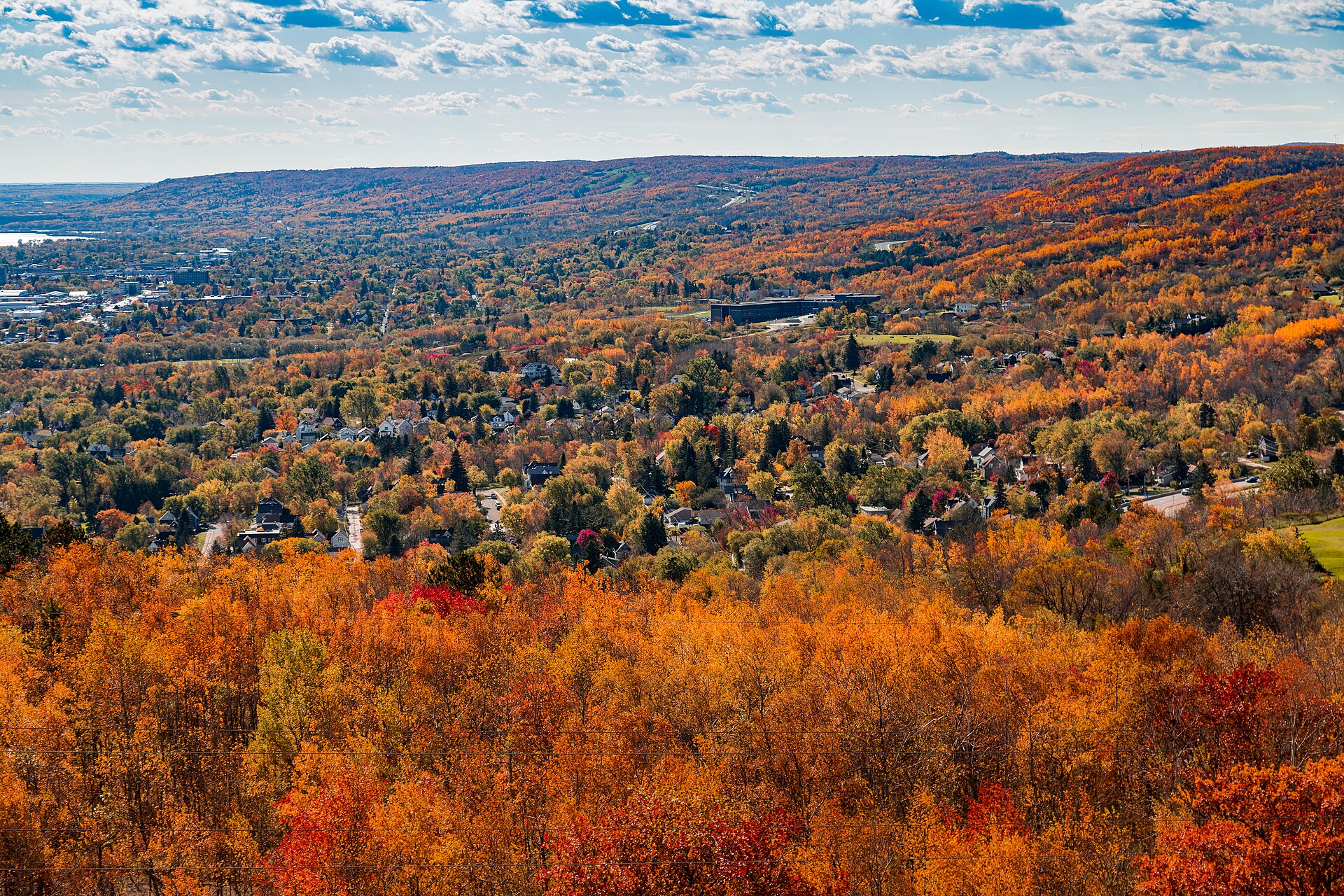
Living in Above the Hill
Every other region in this guide is organized by its relationship to Lake Superior. This one is organized by its relationship to the ridge.
Duluth is built on a long basalt slope, and the ridgeline that runs behind the city, roughly traced by Skyline Parkway, is a genuine dividing line rather than a figure of speech. Below it, streets drop hard toward the water, views open up, and every winter storm becomes a question about whether the car will make it up the hill. Above it, the land levels out. Lots get rectangular. Driveways get shorter and flatter. Garages appear. The houses get newer, and a meaningful share of them were built after 1960 rather than before 1930.
That single geographic fact drives most of what this region is. It is where Duluth put its post-war growth, because it was the only ground left that could be developed conventionally. It is where the city's retail landed, in the Miller Hill corridor, which now functions as the practical daily center for a large part of the metropolitan area. It is where the airport sits. And it is where buyers end up when they have spent a winter on a hillside street and decided they are finished with it.
The four neighborhoods here are more alike in price than in character. Kenwood, Piedmont and Woodland all sat within about $10,000 of each other in June 2026, near $300,000, which is essentially the citywide median of roughly $290,000 (Redfin, accessed 2026-08-13). What separates them is what each one is near. Kenwood has the walkable grocery and the shortest reach to both the university and the shopping. Woodland has the streetcar-era bones and the widest household mix, shaped by its proximity to the University of Minnesota Duluth. Piedmont looks down over the harbor and backs onto some of the best mountain biking in the city. Duluth Heights is wrapped around the shopping itself.
Duluth Heights needs a specific caution, and this guide gives it rather than publishing a tidy number. Its recent published median of $450,000 comes from a three-month window and sits well above the $220,000 to $400,000 range that describes the neighborhood's actual housing stock. The Census tract that best covers it also reports figures that do not match the neighborhood's own housing description. Both are flagged on the neighborhood page. The honest reading is that Duluth Heights is a small, mixed, thinly-traded neighborhood where the published statistics are unreliable and the comparables are what matter.
The region's other distinguishing feature is trail access from the back side rather than the lake side. The Duluth Traverse singletrack, Piedmont's rocky technical trails, Hartley Park on the Woodland and Kenwood edge, and Chester Park's upper reaches all sit in or against this region. Duluth maintains roughly 170 greenspaces totaling about 12,000 acres, about a quarter of the city (City of Duluth, accessed 2026-08-13), and a good share of the riding is up here.
What this region does not offer is the postcard. Lake views are limited and mostly distant, the architecture is more ordinary, and the neighborhoods do not have the intact historic streetscapes that make Congdon or the East End feel like somewhere specific. Buyers choosing above the hill are usually making a deliberate trade of character for practicality, and the ones who are happiest here made that trade knowingly.
What homes cost here: Roughly $220,000 to $430,000 across the region, June 2026, with Kenwood, Piedmont and Woodland all clustered near $300,000 (Redfin, accessed 2026-08-13). Duluth Heights is the exception and its published figures conflict; see the neighborhood page.
Every neighborhood in Above the Hill
Duluth Heights
The city's most convenient address, wrapped around the Miller Hill shopping district and closest to the airport.
Kenwood
A grocery you can walk to and eight minutes to everything else, which is a rarer combination in Duluth than it sounds.
Piedmont
Harbor views out the front and rocky singletrack out the back, at the most affordable price above the hill.
Woodland
The streetcar suburb that grew into the university neighborhood, with the widest mix of households on this side of the ridge.
School districts serving Above the Hill
All four neighborhoods are in Duluth Public Schools (ISD 709), and this is the region where the district's two pathways meet, so the answer genuinely depends on the address.
Kenwood and Woodland both feed Homecroft Elementary, about 448 students, then Ordean East Middle School, about 1,037, then Duluth East High School, about 1,495 (NCES Common Core of Data, 2024-2025, accessed 2026-08-13). Piedmont feeds Piedmont Elementary, about 410, then Lincoln Park Middle School, about 606, then Denfeld High School, about 951.
Duluth Heights is the unresolved one. It straddles both a middle school and a high school boundary, meaning parts of it feed Lincoln Park Middle and Denfeld while other parts feed Ordean East and Duluth East. The published district maps do not settle it cleanly at the edges. This guide will not guess, because school assignment is the field families weight most heavily. Call ISD 709 enrollment with the specific address.
Both comprehensive high schools are reachable from this region, and the College of St. Scholastica and the University of Minnesota Duluth are within about ten minutes of every neighborhood in it, which shapes the housing market in Woodland and Kenwood in particular.
Commute profile
On these figures: The defining number here is Miller Hill, which runs 2 to 8 minutes from anywhere in the region. This is the only Duluth region where the shopping district, not downtown, is the practical center of gravity.
The organizing number above the hill is not the drive downtown. It is the drive to Miller Hill, which runs about 2 minutes from Duluth Heights, 7 from Kenwood, 8 from Piedmont and Woodland. That corridor holds the region's large groceries, the big-box retail and much of its everyday commercial life, and its proximity is the practical reason many households choose this region.
Downtown is a consistent 10 to 11 minutes from all four neighborhoods, which is a genuine advantage of sitting above the slope rather than strung along it. The airport is close, 6 minutes from Duluth Heights and 8 to 11 from the rest, the shortest airport access in the city. Superior is 16 to 19 minutes across the bridges.
Trinity Road, Central Entrance, Arrowhead Road, Woodland Avenue and Rice Lake Road are the through routes, and I-35 and Highway 53 are both quickly reachable. Skyline Parkway runs the ridge along the region's lower edge and is scenic rather than practical, with seasonal closures on parts of it.
Transit coverage is moderate and oriented toward the shopping corridor and the universities rather than toward every residential street, so most households here run on cars (DTA, accessed 2026-08-13). Winter is the region's quiet advantage. The snow totals are not lower and the exposure up here is real, but the grades are far gentler, driveways are flat, and the daily anxiety of getting up an icy hill largely disappears. For a household that has spent a season on a steep lakeside street, that difference is the whole argument.
Who Above the Hill suits
Above the Hill suits households that want a conventional house on a conventional lot, short drives to daily errands, and a winter that does not require a strategy.
It works well for families who want a garage, a flat driveway and a yard without paying a premium for a view. It works for buyers who want new construction, since almost all of Duluth's is here. It works for anyone who flies often or shops often, given the airport and the Miller Hill corridor. And it works well for outdoor-oriented households whose sport is riding rather than lakeshore walking, because the singletrack access from Piedmont and the Traverse is genuinely at the door.
It suits people less well if the reason for moving to Duluth is Lake Superior. The views up here are distant and partial, the Lakewalk is a drive, and the neighborhoods do not have the historic character that draws people to the east side or the hillside. Buyers who want an intact 1910 streetscape, or who want to walk to a lakefront coffee shop, will be happier somewhere else in the city and should treat the easier winter as the compensation it is rather than the point.
Common questions about Above the Hill
What does 'above the hill' mean in Duluth?
It means above the ridgeline that runs behind the city, roughly along Skyline Parkway. Below it, streets fall steeply toward Lake Superior. Above it, the land flattens out. The distinction is material to views, winter driving, lot shape and price, which is why this guide treats it as its own region.
Which neighborhoods are above the hill?
Four: Kenwood, Woodland, Piedmont and Duluth Heights. That is the whole region, and all four are written, so this is the one Duluth region in this guide with no pages still to come.
Is it cheaper above the hill than on the lake side?
Usually, but not dramatically. Kenwood, Piedmont and Woodland all sat near $300,000 in June 2026, close to the citywide median of roughly $290,000. What you gain is not price so much as a flatter lot, an easier winter approach and more new construction.
Do above-the-hill neighborhoods go to Duluth East or Denfeld?
It depends which one. Kenwood and Woodland feed Ordean East Middle and Duluth East. Piedmont feeds Lincoln Park Middle and Denfeld. Duluth Heights straddles both boundaries and is not resolved in the published maps, so confirm it with ISD 709 for the exact address.
Are winters easier above the hill?
The grades are, which is the part that ruins most people's winter. The snow is not necessarily lighter, and the region sits higher and more exposed, but you are far less likely to be stuck on a steep icy street trying to get home.