Lincoln Park District
The West End that became the Craft District, and the hinge between downtown and West Duluth.
Living in Lincoln Park District
This district gets its own region in this guide for a practical reason: it does not behave like the places on either side of it.
Geographically it runs from about 15th Avenue West to 40th Avenue West, climbing from the harbor and I-35 up the hillside toward Skyline Parkway. That puts it between downtown and West Duluth without belonging to either. It is six minutes from the central business district, closer than most of the east side, and twelve minutes from Superior. Group it with Denfeld and Spirit Valley and you lose what makes it different; group it with downtown and you lose the fact that it is a dense residential hillside of two and three-bedroom houses.
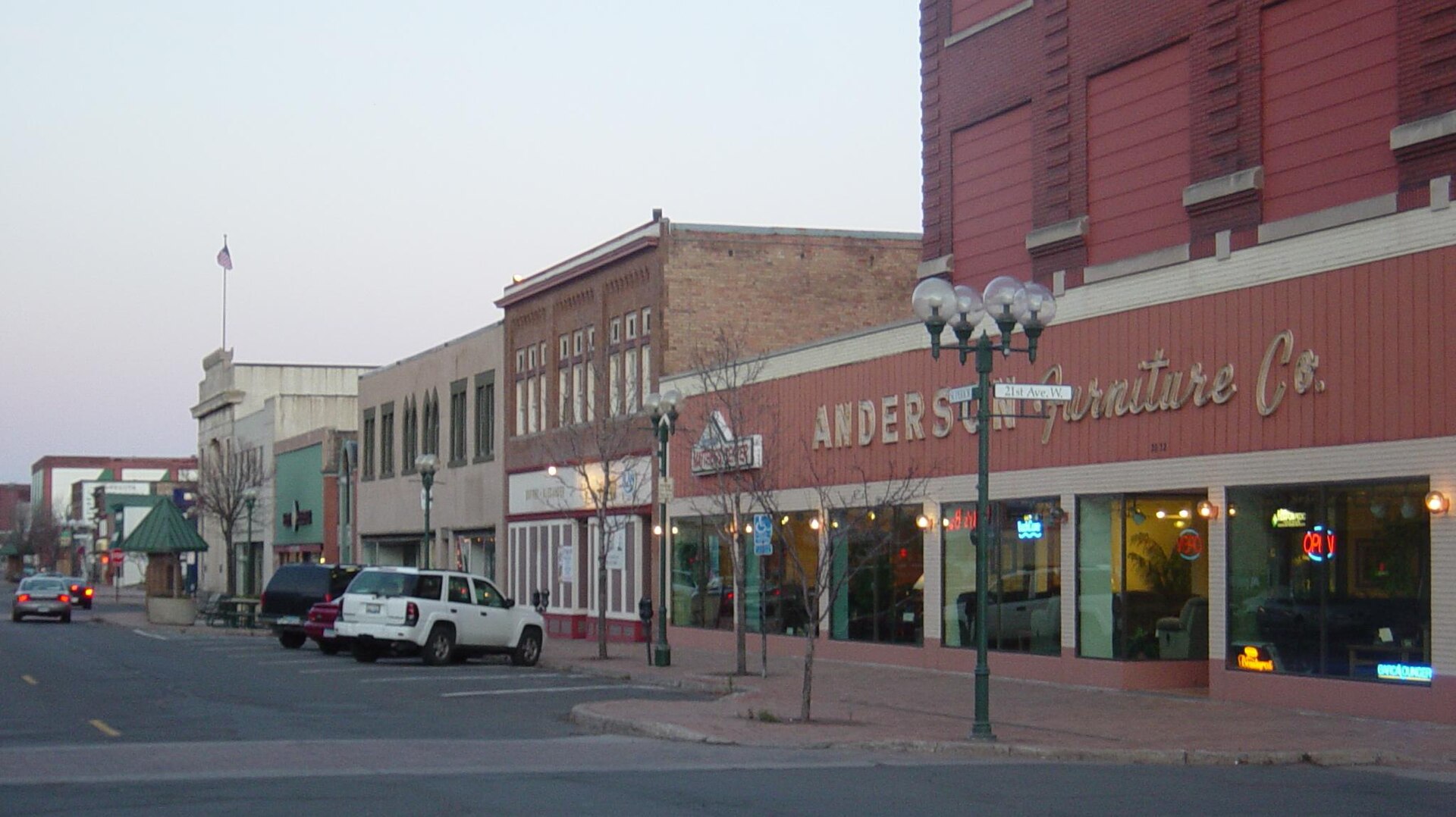
The district was built between roughly 1885 and 1940 as housing for people working the docks, the rail yards, the mills and the manufacturing along the St. Louis Bay waterfront. The housing reflects exactly that: modest, dense, close to the work, on narrow lots with alleys and detached garages. Its commercial spine on West Superior Street served that population directly and functioned as a self-contained main street, which is why a stock of solid brick commercial buildings exists here at all.
When the industrial base contracted through the later twentieth century, the commercial core emptied with it, and the district spent a long stretch as a part of Duluth that people from other neighborhoods did not visit. What reversed that is unusually well documented. Craft manufacturers took the cheap, well-built brick buildings, starting with waxed canvas gear and craft beer, and a city loan program aimed specifically at this ZIP code helped further businesses renovate along the corridor (Star Tribune, accessed 2026-08-13). Institutional investment followed, with Ecolibrium3 running a dedicated Lincoln Park program on energy efficiency, housing and neighborhood planning, and LISC Duluth naming the area a designated focus.
The result is concentrated in about two blocks between 18th and 20th Avenue West, and for a city this size it is genuinely dense: several breweries and cideries, a cider house, well-known restaurants, a bakery, and a canvas goods manufacturer, within a short walk of each other. Visit Duluth markets it as a destination and people drive across the city to spend an afternoon in it.
The housing has not caught up with the commercial story. That is the opportunity and the risk stated as one sentence. Redfin put the mid-2026 median at $165,000 and about $113 per square foot, against a citywide median near $290,000 at roughly $186 per square foot (accessed 2026-08-13). A buyer is purchasing at half the city's per-foot price within walking distance of the busiest new commercial corridor in Duluth. The counterweight is that the year-over-year price figure has swung hard on a thin number of sales, so it should be read as noise rather than direction, and that the housing is old, dense and industrial-era, which means real inspection work rather than cosmetic updating.
The district's other advantage is terrain. Lincoln Park itself, the park the district is named for, holds a creek gorge and a waterfall inside the neighborhood, and the Piedmont singletrack and the Duluth Traverse are reachable without driving. A weekend of a trail ride, a waterfall walk and a taproom, on foot, is available here at a price per square foot that would not buy any of it elsewhere in the city.
What a buyer should do is walk several blocks rather than judging from the district core. The contrast between renovated and unrenovated is the visual signature of the place, and it varies street by street. The upper blocks toward Skyline are quieter with harbor views; the lower blocks near I-35 and the rail corridor are noisier and cheaper.
What homes cost here: Roughly $110,000 to $250,000, with a June 2026 median of $165,000 and about $113 per square foot, against a citywide figure near $290,000 and $186 per square foot (Redfin, accessed 2026-08-13). The lowest entry point of any Duluth region in this guide.
Every neighborhood in Lincoln Park District
School districts serving Lincoln Park District
The district is in Duluth Public Schools (ISD 709) and sits on the west-side pathway: Lincoln Park Middle School, then Denfeld High School, which enrolls about 951 students (NCES, accessed 2026-08-13).
Lincoln Park Middle School is physically in this district but serves a much larger catchment across western Duluth, including Piedmont, Denfeld, Spirit Valley, Morgan Park and Fond du Lac. Families comparing the west-side pathway against the east-side one are comparing Denfeld against Duluth East, and the honest summary is that Duluth East is the larger school with the broader course catalog, while Denfeld is smaller and its neighborhood is walkable to it from a much lower price point.
Elementary assignment in this district is not stated here because the published maps do not resolve it cleanly for every address in the region, and school assignment is the field families weight most heavily. Confirm it with ISD 709 enrollment against the specific address.
Stella Maris Academy operates Catholic campuses elsewhere in the city, and the College of St. Scholastica and the University of Minnesota Duluth are each about ten to fifteen minutes away.
Commute profile
On these figures: The most central non-downtown location in the city. Six minutes to downtown, twelve to Superior, and I-35 runs along the district's southern edge.
This is the most central non-downtown position in Duluth. Downtown is about 6 minutes, Superior about 12 across the bridges, Miller Hill about 10, and the airport about 14. I-35 runs along the southern edge of the district with direct access, which is what makes those numbers work.
West Superior Street is the spine and carries real traffic volume through the middle of the district. Residential streets above it are narrow, often lined with parked cars, and steep enough to ice in winter. The grades here are hillside grades, closer to the east side's problem than to the flat ground above the hill, and the stairs between streets are a genuine feature of the neighborhood rather than a curiosity.
Transit service along the Superior Street corridor is among the better coverage in the city, given the corridor's directness into downtown (DTA, accessed 2026-08-13). Walkability within the commercial core is high and drops off quickly as you climb.
On safety, this district carries a reputation in Duluth that runs behind its current reality, which is a common pattern where change has been fast. For anything beyond impression, use city-published trend data rather than reputation. The Duluth Police Department's 2025 Annual Report is the right starting point, and citywide counts of both violent and property offenses have trended down over recent years (accessed 2026-08-13). Conditions vary by block: lighting and sidewalk quality are inconsistent, the lower blocks near the highway and rail corridor are busier and noisier, and the upper hillside is quieter.
Who Lincoln Park District suits
The Lincoln Park district suits buyers who want the most house and the most walkable evening life per dollar available in Duluth, and who are comfortable buying into a neighborhood that is visibly still changing.
It works for first-time buyers, because the entry point is genuinely low for a city neighborhood with this much within walking distance. It works for young professionals who want taprooms, restaurants and trail access on foot rather than by car. It works for investors and small landlords, given the price per square foot and the rental demand near downtown. And it works for outdoor-oriented households on a budget, since the creek gorge, the waterfall and the singletrack are all reachable without driving.
It suits people less well if they want a finished streetscape. The gap between renovated and unrenovated is wide, it varies block to block, and it will not close on any schedule a buyer can count on. Households whose first priority is the largest high school with the broadest course catalog should look at the east-side pathway instead. Anyone who wants a flat lot, a wide driveway and an easy winter approach will do better above the hill. And buyers who need stable, legible price data should know that this neighborhood's year-over-year figures have been volatile enough that only the medians and the per-square-foot comparison are worth leaning on.
Common questions about Lincoln Park District
Is Lincoln Park the same as the Craft District?
Same place, two names, and both are current. Locals have called it the West End for over a century. Since roughly the mid-2010s the concentration of breweries, cideries and makers on West Superior Street has been marketed as the Craft District. The commercial name describes about two blocks; the neighborhood is much larger.
Why is this district its own region rather than part of West Duluth?
Because it functions differently. It sits between downtown and West Duluth rather than in either, it is six minutes from the central business district, and its commercial corridor draws visitors from across the city. Grouping it with Denfeld and Spirit Valley would obscure both.
How affordable is Lincoln Park really?
It posted a June 2026 median of $165,000 at about $113 per square foot, against a citywide median near $290,000 at about $186 per square foot (Redfin, accessed 2026-08-13). It is the lowest entry point of any Duluth region in this guide.
What schools serve the Lincoln Park district?
Duluth Public Schools (ISD 709), on the west-side pathway: Lincoln Park Middle School and then Denfeld High School, which enrolls about 951 students. Confirm elementary assignment with the district for a specific address.
Is Lincoln Park a good investment?
It has the clearest appreciation story in the city and the commercial recovery is documented rather than speculative. It also carries real risk: the housing stock has not caught up with the commercial story, the year-over-year price data is volatile on thin sales, and older industrial-era houses need genuine inspection work. Treat it as a considered bet, not a sure one.