Far West Duluth
The river corridor: the oldest ground in the city, the lowest prices, and the longest drive to everything.
Living in Far West Duluth
Every other Duluth region is oriented to Lake Superior. This one is oriented to the river.
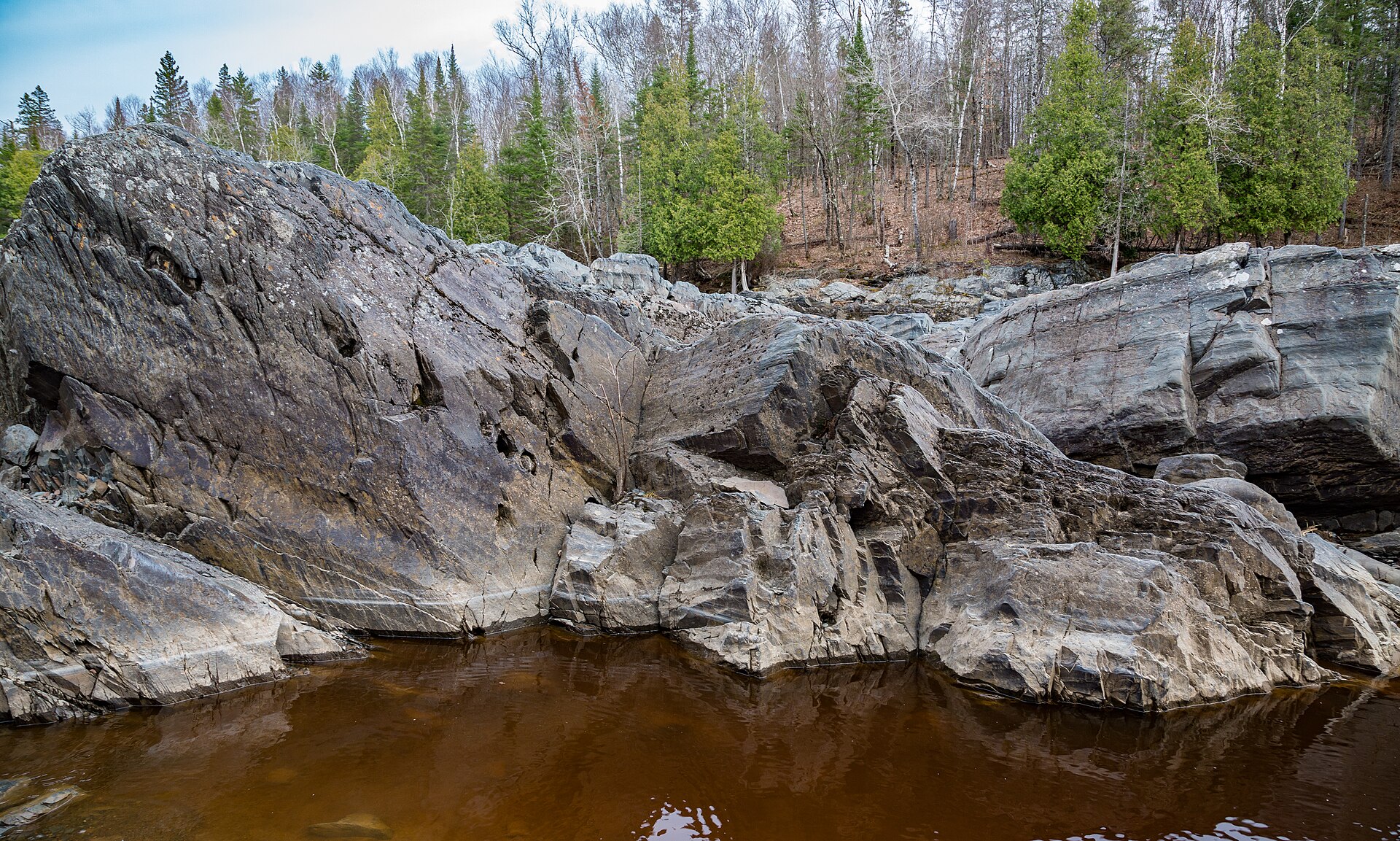
The St. Louis River runs southwest out of the harbor, widens into an estuary, then narrows into the gorge below Jay Cooke State Park. The neighborhoods of far west Duluth are strung along that corridor, fourteen miles or more from downtown at the far end, closer to Cloquet than to the center of their own city. That distance is the region's defining fact, and it produces everything else about the place: the prices, the quiet, the thin services, and the kind of household that chooses it.
This is also the oldest ground in Duluth by a wide margin. Fond du Lac was an Ojibwe community, known in Ojibwe as Nagaajiwanaang, for centuries before any of the rest of this city existed. The American Fur Company established a trading post there in 1817, a mission followed in 1833, and two treaties bearing the place's name were negotiated and signed on that ground, in 1826 and 1847 (Treaties Matter, accessed 2026-08-13). The 1826 treaty opened Ojibwe land north of the Prairie du Chien line to mineral exploration, which is the legal thread connecting this riverbank to the iron ore that built Duluth twenty miles east. Nagaajiwanaang is the namesake of the Fond du Lac Band of Lake Superior Chippewa, whose reservation today lies west of here at Cloquet and Sawyer in Carlton County. A settler townsite was platted over the fur post ground in 1856, and Duluth annexed the place in 1895.
Morgan Park is the other kind of history entirely, and it is unusual enough to be worth the drive even for people who will never buy here. US Steel built it in the early twentieth century as a company town for workers at its Duluth plant, constructed largely in concrete, with its own housing, school, church and community buildings laid out as a planned whole. It was built as a segregated company town under company rules that reflected the era. That describes the past, not who lives there today. The mill closed decades ago, and the neighborhood outlived it, still visibly distinct from anywhere else in the city.
For a buyer, the practical picture is straightforward. This region has the lowest housing costs in Duluth, with a working range of roughly $130,000 to $260,000. Only one of the six neighborhoods has a publishable median, and the silence elsewhere is not an oversight: these are places that turn over a handful of houses a year across housing stock with little comparable in it, and any median computed on that sample would be noise. Gary-New Duluth is the exception because it closes enough sales to compute one, which makes it the easiest neighborhood in the region to price and a useful anchor for the rest. Third-party figures for Fond du Lac accessed in August 2026 ranged from about $190,000 to $310,000 for the same neighborhood, which is a measurement problem rather than a disagreement about value. Price from actual close comparables, and expect appraisal to be a negotiation rather than a formality.
What the money buys is space, river and forest. Jay Cooke State Park and the gorge sit at the region's western end, the Fond du Lac State Forest spreads beyond that, Chambers Grove Park is on the river inside Fond du Lac, and the Mission Creek end of the Duluth Traverse singletrack is the nearest riding. The estuary below Morgan Park is among the best paddling and fishing water in the region.
What it does not buy is convenience. Services thin out fast. Fond du Lac has no store, no school and no commercial block at all. The social and commercial center for this end of the city is Gary-New Duluth, and beyond that Spirit Valley. Anyone weighing this region should count the drive honestly, in hours per week rather than minutes per trip, and should look hard at septic, well, flood history and floodplain status for the specific parcel.
What homes cost here: Roughly $130,000 to $260,000. Only one neighborhood in this region has a publishable median: Gary-New Duluth, at about $207,000 on the most recent month against $180,500 on the trailing twelve. The rest are left null because they turn over too few houses a year for a median to mean anything, and this guide will not borrow the citywide figure of roughly $290,000 to fill the gap (Redfin, accessed 2026-08-13). Price from actual close comparables here.
Every neighborhood in Far West Duluth
Fond du Lac
The oldest community in Duluth and the farthest from the rest of it, where the St. Louis River comes out of the Jay Cooke gorge.
Gary-New Duluth
Two company-era river towns treated as one, and the service center the rest of the far west end depends on.
Morgan Park
The concrete company town US Steel built for its mill workers, still standing and still distinct a century later.
Norton Park
Where the Munger Trail starts, between two creeks on the river, and the closest of these neighborhoods to the rest of the city.
Riverside
A shipyard village on Spirit Lake, with the Munger Trail running through the middle of it.
Smithville
River-corridor housing below and Bardon Peak above, with a radical labor college in its past.
School districts serving Far West Duluth
All six neighborhoods are in Duluth Public Schools (ISD 709) and five of them share one pathway: Stowe Elementary, about 245 students, then Lincoln Park Middle School, about 606, then Denfeld High School, about 951 students (NCES Common Core of Data, 2024-2025, accessed 2026-08-13). Norton Park is the exception, feeding Laura MacArthur Elementary, about 277 students, before joining the same middle and high schools.
The distance is the point. Every school serving this region is well outside it, and from Fond du Lac in particular the bus ride is the longest in this guide at every grade level, for the full thirteen years of a school career. That is a real cost and it is measured in hours rather than in miles. Households with school-age children should treat it as one of the two or three decisive facts about the region, alongside the commute and the price.
The Fond du Lac Ojibwe School operates in Cloquet, in the Fond du Lac Band's reservation community west of here, and serves families in that community rather than functioning as a district assignment for these Duluth neighborhoods.
Attendance boundaries change. Confirm any specific address with ISD 709 enrollment before school assignment factors into an offer.
Commute profile
On these figures: The longest commutes of any Duluth region, and the defining constraint on living here. Morgan Park runs about 20 minutes downtown, Fond du Lac about 24. Cloquet is closer than downtown Duluth from the western end.
These are the longest drives in the city and there is no way to soften that. Morgan Park is about 20 minutes to downtown, 18 to Miller Hill, 22 to Superior and 24 to the airport. Fond du Lac adds roughly four minutes to each: 24, 22, 26 and 28. From the western end, Cloquet is closer than downtown Duluth.
Highway 23 is the corridor and effectively the only route, running along the river from West Duluth out past Fond du Lac toward Carlton County. Grand Avenue connects the eastern end back into Spirit Valley and the rest of the city. There is no interstate access at the far end and no alternate route if the highway closes.
Transit coverage is thin at this end of the city, and every neighborhood here is car-dependent in practice. It is not absent, though: the DTA's own schedule data shows Route 103, the long cross-city line to the Transportation Center and UMD, with stops through Gary-New Duluth, Smithville, Riverside and Norton Park, so a car-free trip downtown is possible if the timetable suits you (Duluth Transit Authority GTFS feed, accessed 2026-08-14). What is missing is frequency and any second option. Walk scores reflect the same picture, running from 36 in Norton Park down to 12 in Fond du Lac, the lowest in this guide. There is no sidewalk network in Fond du Lac and no commercial destination to walk to.
Winter adds to the drive rather than changing its character, since Highway 23 is a maintained state route and the terrain along the river is gentler than the city's hillsides. The greater practical concerns are distance from emergency services, roughly a twenty-four minute drive to a hospital from Fond du Lac, and the plain fact that everything is a trip.
Who Far West Duluth suits
Far west Duluth suits households that want land, river and forest at the lowest prices in the city, and that have genuinely made peace with the driving.
It works for retirees who have stopped commuting, for remote workers whose commute is a hallway, and for people whose work or recreation is outdoors and seasonal. It works for buyers purchasing acreage and quiet rather than a neighborhood and its services. It works for anyone drawn to a place with real documented history under it, which this region has more of than anywhere else in Duluth. And Morgan Park in particular works for buyers who want architectural distinctiveness at a budget price and will do the homework a concrete company-town house requires.
It suits people less well if there are school-age children in the household, because the bus ride is the longest in this guide and it lasts thirteen years. It suits people poorly if groceries, a pharmacy or a clinic need to be close, or if a twenty-plus minute drive to a hospital is a worry. And it will frustrate anyone who wants neighbors within sight, a walk to anything, or a community they can join without driving to it. Buyers who want the same value with services and a school district next door should look at Cloquet; those who want to stay in Duluth at similar prices but closer in should look at Denfeld and Spirit Valley.
Common questions about Far West Duluth
Which neighborhoods are in far west Duluth?
Six, all written: Norton Park, Riverside, Smithville, Morgan Park, Gary-New Duluth and Fond du Lac, running southwest along the St. Louis River from West Duluth to the Carlton County line.
Why do most neighborhoods in this region have no median price?
Because they sell a handful of houses a year. A median computed on that sample is noise, and borrowing the citywide figure of roughly $290,000 would mislead in both directions. Gary-New Duluth is the one exception, at about $207,000, because it closes enough sales to compute one. Elsewhere the working range is about $130,000 to $260,000 and you should price from actual close comparables.
How long is the commute from Fond du Lac?
About 24 minutes to downtown Duluth, 22 to Miller Hill, 26 to Superior and 28 to the airport. It is the longest commute in this guide, and Cloquet is closer than downtown Duluth is.
What is Morgan Park?
A company town built by US Steel in the early twentieth century for workers at its Duluth plant, constructed largely in concrete, with its own housing, school, church and community buildings. The mill is gone and the neighborhood remains, architecturally distinct from anywhere else in the city.
What schools serve far west Duluth?
All six are in Duluth Public Schools (ISD 709) on the west-side pathway: Stowe Elementary, Lincoln Park Middle School, then Denfeld High School. Norton Park is the exception at elementary, feeding Laura MacArthur instead. From Fond du Lac the Stowe ride is the longest in the guide at every grade level, which is a real cost worth counting in hours.
Is Fond du Lac really the oldest part of Duluth?
Yes. It was an Ojibwe community known as Nagaajiwanaang for centuries, the American Fur Company put a trading post there in 1817, and two treaties bearing the place's name were signed on that ground in 1826 and 1847. Every other neighborhood in the city is younger than the fur post.