Central Duluth
The working core of the city, where the harbor, the lift bridge and the sandbar meet.
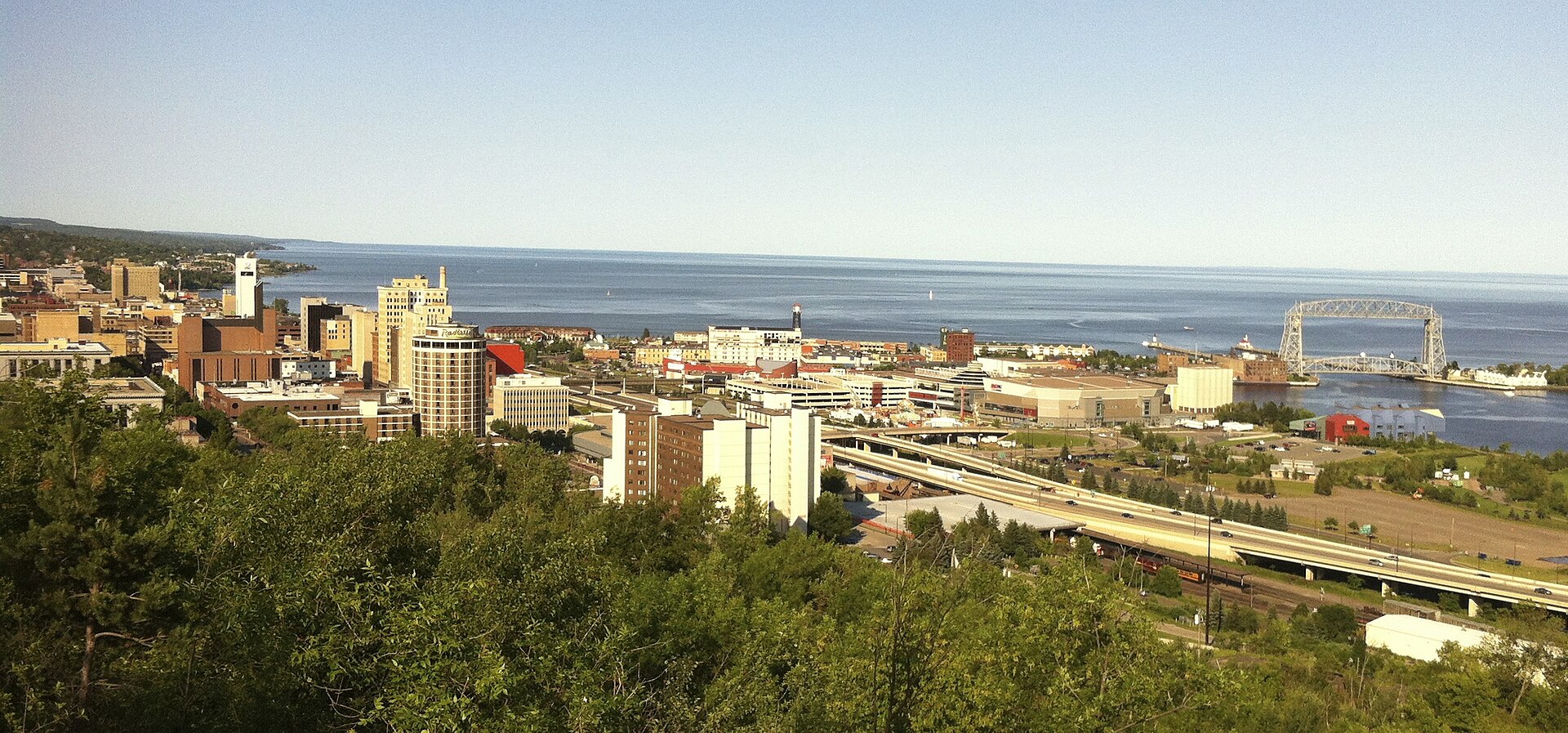
Living in Central Duluth
Central Duluth is where the city does its most public business. The ship canal cuts through here, the Aerial Lift Bridge rises over it several times a day, the ore and grain terminals work the harbor side, and several million visitors a year arrive to watch all of it happen.
Two residential neighborhoods sit inside that. Canal Park is a compact grid of converted warehouses and newer infill on the lake side of the canal, a district that spent its first century as freight and industry and its last forty years becoming the city's front door. Park Point is the other kind of place entirely: a seven-mile sandbar, one of the longest freshwater baymouth bars in the world, with a single road down its length, water on both sides, and a bridge at the top that opens for ships.
What ties them together is not architecture or price. It is that both are defined by the water and by the infrastructure that crosses it. Everything about daily life in this region, including how long it takes to leave, is downstream of the canal.
The pricing here needs a warning label, and this guide gives it one rather than publishing a clean number that would mislead. Park Point posted a June 2026 median of $848,000, up 69.5 percent year over year, while its price per square foot moved in the opposite direction (Redfin, accessed 2026-08-13). Both cannot describe the same market. What actually happened is that a handful of large lakefront sales landed in one month in a neighborhood that turns over very few houses. Canal Park's median is left null on purpose for the same reason, with the added complication that its housing stock is mostly condominiums, which are not comparable to the detached houses behind every citywide figure. In this region you price from actual close comparables on the specific building or the specific stretch of the Point, and you should expect appraisal to be a negotiation.
The compensation for that difficulty is location. Canal Park carries the highest walk score in this guide at 88, and it is the one Duluth address where a household can genuinely operate day to day without a car: groceries, restaurants, the Lakewalk, downtown, and the DECC are all inside a short walk. Park Point offers something no other city neighborhood can, which is a sand beach and open water within sight of the kitchen window, plus the Park Point Recreation Area and the bird sanctuary at the far end.
The costs are equally specific. Canal Park is loud in summer and quiet in a slightly hollow way in February, and the neighborhood's rhythm is set by people who do not live there. Park Point residents deal with the lift bridge, which is not a metaphor: when it is up for a vessel there is no other way on or off, and the wait is whatever the ship needs. Both neighborhoods sit low and exposed, so wind, wave and storm matter in a way they do not on the hill, and any purchase here deserves a careful look at flood history, insurance and shoreline condition for the specific parcel.
Central Duluth is also the region with the most still to come in this guide. Downtown, Central Hillside and East Hillside all sit in this core and have pages in production. What is written today covers the waterfront half of the region rather than all of it, and the Hillside neighborhoods in particular are a different proposition from the two described here: dense, steep, and considerably cheaper.
What homes cost here: The region where published medians are least usable. Park Point posted $848,000 in June 2026 on a very thin sample; Canal Park's median is deliberately left null because the sample is a handful of condominium sales a year (Redfin, accessed 2026-08-13). Price from actual comparables here, not from a neighborhood median.
Every neighborhood in Central Duluth
Canal Park
A warehouse district turned lakefront promenade at the foot of the lift bridge, and the most walkable address in the city.
Central Hillside
Downtown Duluth
East Hillside
Park Point
Seven miles of sand between a working harbor and the largest freshwater lake in the world, reached by a bridge that opens for ships.
School districts serving Central Duluth
Both neighborhoods are in Duluth Public Schools (ISD 709), and then they part ways, which is the most surprising fact in this region.
Canal Park feeds Myers-Wilkins Elementary, then Lincoln Park Middle School, then Denfeld High School, roughly 951 students (NCES, accessed 2026-08-13). Park Point feeds Ordean East Middle School and Duluth East High School, roughly 1,495 students. Two neighborhoods within sight of each other, two different comprehensive high schools.
Park Point's elementary assignment is one of the genuinely ambiguous cases in the district's published maps, and this guide does not guess at it. Central-corridor boundary lines also run through Canal Park. Both are worth a direct call to ISD 709 enrollment before school assignment factors into an offer, since this is the field families weight most heavily and the published PDFs do not resolve it cleanly.
Stella Maris Academy operates Catholic campuses in the central and east parts of the city, and Marshall School is the independent K-12 option. The University of Minnesota Duluth and the College of St. Scholastica are both about ten minutes up the hill.
Commute profile
On these figures: Midpoints of the two neighborhoods. Canal Park is 3 minutes from downtown, Park Point about 10, and Park Point's number can go up without warning when the lift bridge is raised for a ship.
Canal Park is three minutes from downtown and often faster on foot than by car, since the walk crosses one street and a plaza. Park Point is about ten minutes downtown in normal conditions. Miller Hill is roughly 12 minutes from Canal Park and 18 from the Point, Superior 12 to 18 minutes across the bridges, and the airport 15 to 22.
The lift bridge is the defining piece of infrastructure and deserves a plain description. It carries all traffic on and off Park Point, and it lifts on vessel schedule rather than on a timetable convenient to commuters. Residents adapt, mostly by leaving margin, but anyone considering the Point should sit through a lift once before deciding.
Parking is the other structural quirk. Canal Park's parking is largely metered and shared with visitors, and in summer the district absorbs a great deal of traffic that is not going anywhere in particular. Residential parking arrangements vary building to building and should be confirmed as part of any purchase.
Transit coverage in the core is the best in the city simply because everything converges downtown, and the Lakewalk functions as genuine pedestrian and bicycle infrastructure connecting the region east along the shore (DTA, accessed 2026-08-13). Winter here is less about hills, since both neighborhoods are flat, and more about exposure. Wind off the lake and blowing snow across an open sandbar are the conditions to plan for.
Who Central Duluth suits
Central Duluth suits households that want to be in the middle of the city's activity and on the water, and who are buying a specific property rather than shopping a market.
It works for remote workers and retirees who want to trade a yard and a driveway for a short walk to everything. It works for households downsizing out of a hillside house and its winter grades. It works for lakefront buyers with the budget and the patience for a thin, slow, negotiation-heavy market. And it works for anyone whose priority is a car-optional daily life, which Canal Park delivers better than anywhere else in the guide.
It suits people less well if predictability matters. The pricing is genuinely hard, the inventory is thin, the summer is busy, and the bridge is a real constraint rather than a charming one. Families weighing a specific school pathway should resolve the assignment questions first, because this is the one region where two close neighbors land in different high schools. And anyone wanting a conventional house on a conventional lot with a garage will find far more of it, for less money, above the hill or on the west side.
Common questions about Central Duluth
What neighborhoods are in Central Duluth?
Five: Downtown, Canal Park, Central Hillside, East Hillside, and Park Point. This guide currently covers Canal Park and Park Point; Downtown and the two Hillside neighborhoods have pages in production.
Can you actually live in Canal Park, or is it only tourism?
You can. It is a working residential address with condominiums and converted warehouse units, and it carries the highest walk score in the guide. The trade-off is that the neighborhood's daily rhythm is set by visitors, and summer is loud.
Does the lift bridge affect the Park Point commute?
Yes, and it is the single thing residents mention most. The bridge lifts for vessel traffic and there is no alternate route on or off the Point, so occasional unplanned waits are part of living there.
Why does this guide not publish a median sale price for Canal Park?
Because the sample is a handful of condominium sales a year and any median computed on it is noise. Borrowing the citywide figure of roughly $290,000 would be worse, since a Canal Park condominium is a different product entirely.
Do Canal Park and Park Point go to the same schools?
No, and they are barely a mile apart. Canal Park feeds Myers-Wilkins Elementary, Lincoln Park Middle and Denfeld High School. Park Point feeds Ordean East Middle and Duluth East High School. Confirm elementary assignment with ISD 709 for a specific address.